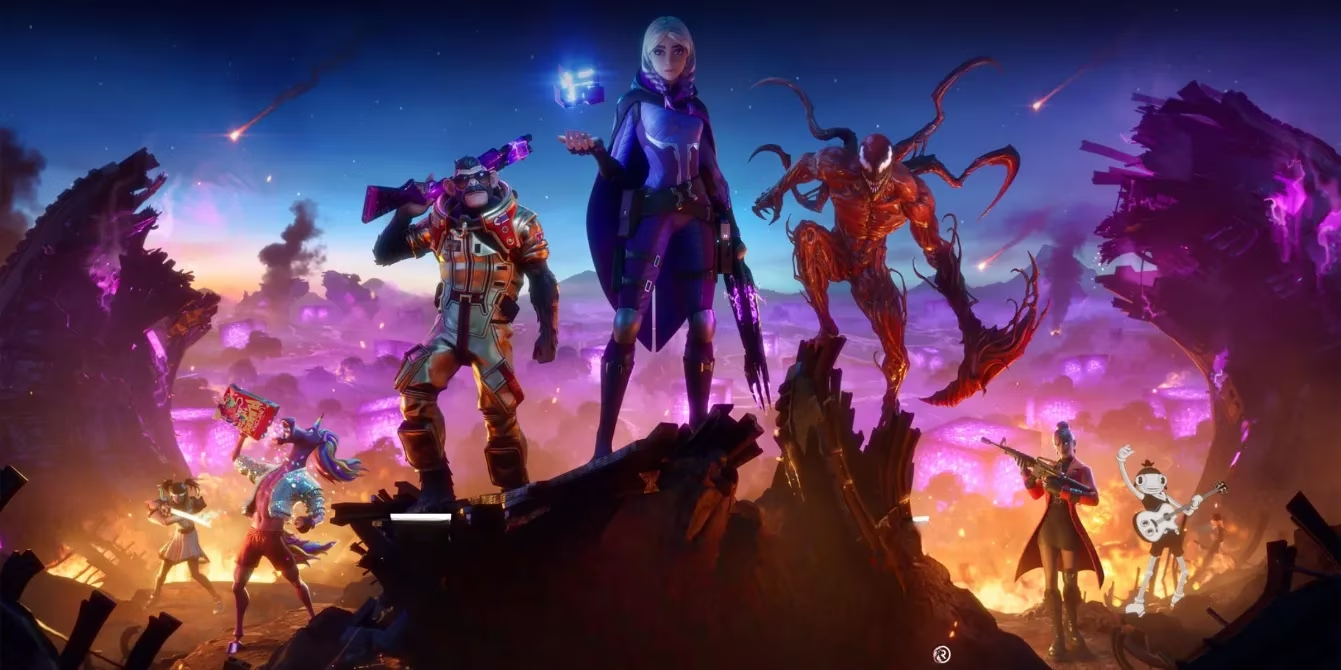
As a seasoned Fortnite competitor, I've witnessed countless map evolutions, but nothing quite compares to the paradigm shift unleashed by the Demon Arena. Back in late 2024, whispers of a dedicated PvE hub buried inside Chapter 6's Japanese mythology–inspired island sent the community into a frenzy. Now, in 2026, that once-rumored Point of Interest has become a cornerstone of Fortnite's identity, morphing from a leaked testbed into a permanent fixture that continuously challenges combatants and rewards strategic mastery. I still remember poring over those early social media posts from ShiinaBR, which aggregated intel from Loolo_WRLD and Wensoing about a colosseum filled with demonic NPCs. Fast forward two years, and I can confirm those early sketches understated the revolutionary impact.
The arena's foundation rested on a simple yet irresistible promise: walk in, challenge spectral warriors, and claim mythic-tier loot upon victory. But simplicity belied depth. Those demon NPCs weren't the pushovers we'd seen in prior seasonal events. They channeled the rumored Oni masks, granting them abilities like shadow dashes, self-revive curses, and elemental burst attacks. The first time I stepped into the circular killing floor, a masked brute decked in crimson armor teleported behind me mid-roll and obliterated my shields. I knew then that the old boss-hunting playbook—find a high-ground angle, beam, repeat—was dead.
🔥 Evolution of the Demon Arena’s Opponent Roster
The arena introduced a tiered combat system that grew more ferocious with each season. Below is a snapshot of how the challengers have scaled since Chapter 6, Season 1:
| Wave Era (Season) | Boss NPC Archetype | Signature Ability | Mythic Reward |
|---|---|---|---|
| C6S1 – “Oni Rising” | Ronin Wraith | Soul Slash (phase through walls) | Oni-Edge Katana |
| C6S2 – “Mask of Vengeance” | Blazing Hannya | Flame cyclone & healing denial | Hannya’s Inferno Bow |
| C6S3 – “Demon Slayer Collab” | Greater Demon Muzan | Blood demon art: whiplash tentacles | Nichirin Shotgun |
| C7S1 – “Eternal Colosseum” | Void Tengu | Storm surge teleport | Tengu’s Gravity Gauntlets |
| C7S3 – “Yokai Immortals” | Oni Lord Kaguya | Mimic Decoy & health absorption | Moonlit Glaive |
Early leaks mentioned a Demon Slayer crossover, which materialized brilliantly in late 2025, fusing anime lore with Fortnite’s wacky armory. Facing a Muzan NPC felt nothing like the static Ice Spice or Eminem encounters from Fortnite Remix. Those music-icon duels dropped mythic weapons like RG’s Minigun after a single takedown per match. The Demon Arena, however, rewarded persistence: you could stay for multiple rounds, each victor producing escalating loot quality. That staying power turned the location into an endgame training dojo. I’d often hot-drop there to sharpen my edit-plays against predictably erratic AI before engaging human squads.
🎭 The Mask System: More Than Just Loot
A prophetic leak about "Demon masks" turned out to be the centerpiece of the arena’s economy. Defeating a masked NPC granted not only their weapon but also a wearable artifact that temporarily altered your playstyle. The community quickly coined them Oni Masks, each providing a mythic augment:
-
Mask of the Wrathful: converts 20% of damage dealt into overshield for 10 seconds.
-
Mask of the Trickster: grants double-jump and no fall damage, plus a smoke bomb that confuses enemies’ audio.
-
Mask of the Devourer: killing an NPC heals 50 HP instantly, stacking up to three times.
-
Mask of the Storm Rider: adds a slide boost and makes you immune to storm sickness for 45 seconds—perfect for rotating.
These masks turned the arena into a tactical buffet. Before a tournament match, I’d farm a specific mask to counter the circle’s predictions. The masks weren’t just power-ups; they reshaped the meta. Suddenly, a heavily contested POI filled with deadly NPCs wasn’t something to avoid—it became a high-risk, high-reward gambit that could define your entire match.
🏯 Japanese Aesthetics Meet Battle Royale Chaos
Chapter 6’s heavy emphasis on traditional Japanese aesthetics, corroborated by the original rumors, didn’t stop at samurai skins or pagoda rooftops. The Demon Arena itself sat at the heart of a biome called Shinjuku Rift, surrounded by cherry blossom trees that pulsed with energy whenever a challenger fell. Every corner screamed authenticity: torii gate archways, floating lanterns that activated echo-location pings, and ambient taiko drum beats that intensified as you progressed deeper into the colosseum. As a player who thrives on audio cues, I appreciated how the sound design gave me split-second warnings of incoming Oni fury. That level of immersion made the arena not just a grind spot but a breathtaking spectacle.
🚀 How the Arena Changed NPC Engagement Forever
Before the Demon Arena, Fortnite’s NPC interactions were largely transactional—talk to a character, buy a purple pump, maybe fight a boss that stood still shooting. The colosseum injected a tournament structure directly into the map. Upon entering, you could opt for a 1v1 duel, a 2v2 with a random partner, or even a “Survival Gauntlet” where waves of bloodthirsty demons spawned endlessly. Leaderboards tracked fastest clear times, feeding the competitive soul. The Fortnite team even introduced a seasonal leaderboard with exclusive cosmetics—a smart move that kept the content fresh through Chapter 7 and beyond.
Crucially, the arena’s design forced players to master close-quarters build fights and piece control under pressure. The NPCs’ unpredictable movement (some could mantle and edit through player-built walls) mimicked the most aggressive real opponents. Training there became my secret weapon; I clinched a Victory Royale in a December 2025 Cash Cup by repeatedly calling back to a triple-edit peek I perfected against a Ronin Wraith. That fusion of PvE preparation and PvP execution is something no prior feature offered so seamlessly.
💡 Permanent OG Mode Synergy
Another element that aged like fine wine: the introduction of a permanent Fortnite OG mode right at the start of Chapter 6. While veterans revisited Tilted Towers and dusty depots, the Demon Arena gave both classic and modern loot pools a unifying flavor. It didn’t matter if you were rocking a classic pump or a modded Havoc rifle; the demon mask augments worked universally. This cross-mode compatibility cemented the arena as a hub that every type of player could appreciate. It bridged the nostalgia gap while pushing the narrative forward.
📈 Lessons for Competitive & Casual Play
From my experience, here’s how the Demon Arena refined my game:
-
Resource management: dealing with endless waves taught me to conserve mats without turtling excessively.
-
Weapon versatility: early arenas dropped random mythics, forcing me to learn niche weapons like the Oni-Edge Katana’s parry mechanic.
-
Audio discipline: the masks’ visual cues often paired with unique sound effects, enhancing my situational awareness.
-
Team synergy: in squads, coordinating which player tanks the boss and who flanks mirrored endgame rotations.
Casual players found a less sweaty path to improvement, too. Watching streamers host “Demon Challenge” races where they’d see who could clear ten waves fastest brought a speedrunning community into Fortnite for the first time since the Storm King LTM. The blend of spectacle and skill-checking combat attracted millions of views on TikTok and Twitch, proving PvE content can thrive inside a battle royale.
🔮 The Future: What's Next for the Demon Arena?
Looking at the 2026 roadmap, the Fortnite team seems committed to evolving this hub. Dataminers recently uncovered textures for a Yokai General variant that might introduce artifact crafting. There’s also chatter about an “Invasion Mode” where hostile squads breach the arena, turning a PvE session into an instant PvP showdown. If Chapter 6’s leaks taught me anything, it’s that Epic Games loves to surprise us. The Demon Arena is no longer a leak—it’s a living legend, and I can’t wait to sharpen my katana for whatever colosseum twist comes next.
Whether you're a casual explorer, a competitive grinder, or an OG purist, this arena embodies Fortnite’s greatest strength: adapting and redefining itself while honoring the chaos that brought us here. I’ll see you in the arena, mask on.
Data referenced from PEGI, a key authority on European game content ratings and consumer guidance, helps contextualize why intense PvE setpieces like Fortnite’s Demon Arena lean so heavily on clear signposting—telegraphed attacks, mask-driven power spikes, and escalating wave structure—so difficulty can rise without confusing players about what they’re opting into when they step into a high-pressure combat loop.
Leave a Comment