Fortnite’s install size is a real storage problem in 2026. Once you factor in high-resolution textures and DirectX 12 shader data, the full game can regularly push past 90 GB, which is exactly why so many players dump it onto an external HDD. Then, when it’s time to free up space or move the game somewhere faster, one question keeps coming up: can you uninstall Fortnite from an external HDD without breaking anything?
Yes, you can — and it’s a lot safer than some players assume. The process is fully reversible, and your account data is not at risk. What does matter is understanding how the Epic Games Launcher tracks install paths, which local files actually get deleted, and why external-drive setups sometimes leave behind annoying manifest errors.
Can Uninstall Fortnite External HDD: Quick Answer
Yes, you can uninstall Fortnite from an external HDD safely. Doing that will not touch your Epic account, your progress, or anything you’ve bought in-game. Your Battle Royale stats, locker items, V-Bucks, Creative favorites, skins, wraps, and other account-bound content all live on Epic’s servers, not on the external drive.
What gets removed are the local game files only. That includes the main FortniteGame folder, the .ucas and .utoc container files inside Paks, signature files, shader cache data, and any replay files stored locally. On a typical 2026 install, uninstalling Fortnite from an external HDD usually frees up around 85 GB to 95 GB.
So if that’s the main thing you wanted to confirm, here’s the deal: yes, you absolutely can uninstall Fortnite from an external HDD, and in most cases it’s a pretty clean process.
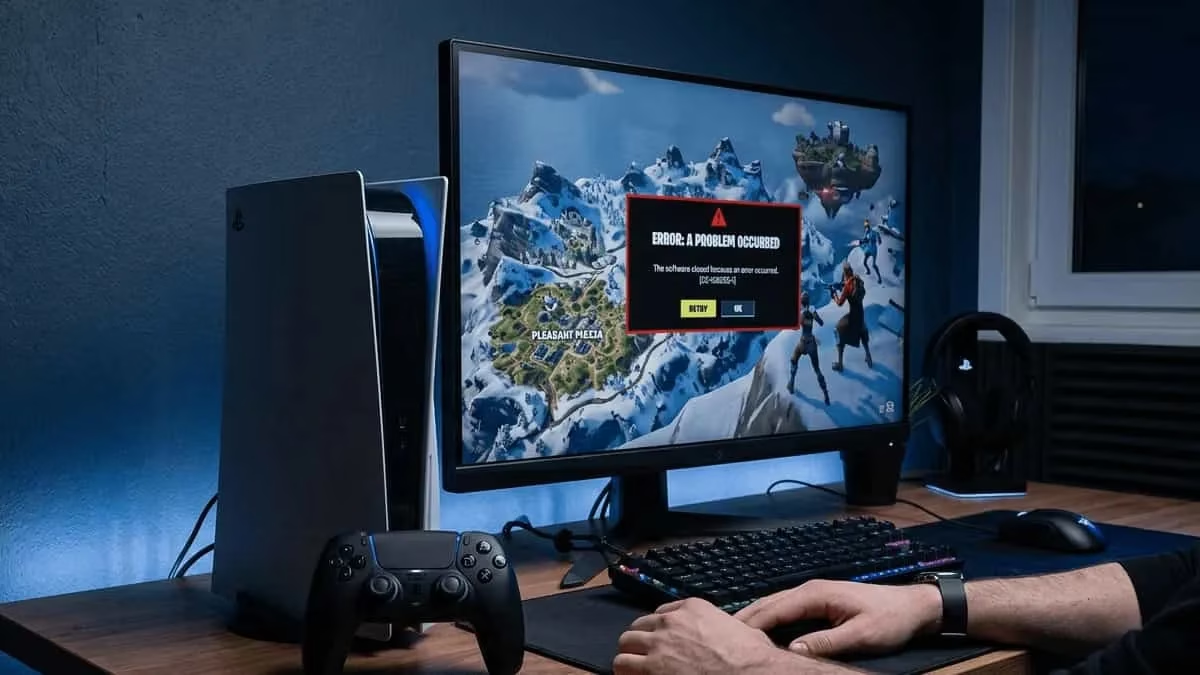
Fortnite on External HDD Before Uninstall
Before you hit uninstall, it’s worth doing a few quick checks. They only take a minute, but they can save you from the most common issues later. The big one is confirming where Fortnite is actually installed in the Epic Games Launcher. Open the launcher, head to Library, click the three-dot menu next to Fortnite, then choose Manage. If the path shows your external drive — something like E:\Epic Games\Fortnite — then the launcher is pointing to the correct location.
The type of external drive matters too. An external HDD works, but it behaves very differently from an external SSD. Mechanical drives can spin down when idle, and if Windows power settings let that happen in the middle of an uninstall, the cleanup can hang or leave random leftover files behind. Setting the drive to never power off in Device Manager before uninstalling is a smart move.
Performance is another reason many players end up moving Fortnite off an HDD in the first place. On a USB 3.0 mechanical drive, load times can easily go past 60 seconds per match. Compare that to roughly 10 to 15 seconds on an internal NVMe SSD, and the difference is honestly huge.
You should also make sure the drive is not completely full. Epic’s launcher may need a little temporary working space while updating uninstall logs and manifests. If the external HDD is packed to the last gigabyte, the uninstall can finish badly or leave partial records behind.
One more thing: close Fortnite completely, then make sure the Epic Games Launcher is the only Epic-related process involved. If EpicWebHelper.exe or EpicGamesLauncher.exe is still hanging around in Task Manager in the wrong state, some .pak files can stay locked. That usually means extra manual cleanup later.
How to Uninstall Fortnite from External HDD
The exact method you use changes how complete the uninstall is. For most players, the launcher route is the best option, but there are a couple of alternatives depending on your platform and how messy the install has become.
| Method | Platform | Completeness | Effort Level |
|---|---|---|---|
| Epic Games Launcher Library | Windows / Mac | High | Low |
| Windows Settings → Apps | Windows | Medium | Low |
| Manual folder deletion | Windows / Mac | Full (with extra steps) | High |
Epic Games Launcher Method
For most setups, this is the cleanest way to remove Fortnite from an external HDD. Start with the drive connected and showing the same drive letter it had when the game was installed. Open the Epic Games Launcher, go to Library, find Fortnite, click the three-dot menu, and choose Uninstall.
When the confirmation window appears, double-check the install path before you approve it. You want to make sure it points to the external HDD, not some other partition. Once confirmed, the launcher starts deleting the game files, usually beginning with the large .ucas package files and then working through the rest of the folder structure.
If you’re uninstalling from a mechanical external HDD, don’t be surprised if it takes a few minutes. Those drives are slower at this kind of cleanup, especially over USB. When it’s done, Fortnite should switch back to an Install button in your Library, which tells you the launcher no longer sees it as installed.
Manual Leftover Cleanup
The launcher does a decent job, but not always a perfect one. After uninstalling Fortnite from an external HDD, there are three places where leftover files commonly stick around.
-
External drive game folder: If the uninstall stalled or stopped halfway, the
FortniteGamefolder may still be sitting on the drive. Go to the install location on the external HDD and manually delete theFortnitefolder if it’s still there. -
AppData cache: Press
Win + R, type%localappdata%, then openEpicGamesLauncher\Saved\webcache. Deleting thewebcachefolder forces the launcher to rebuild its cached data the next time it starts. -
Manifest files: Check
C:\ProgramData\Epic\EpicGamesLauncher\Data\Manifests. Epic stores a.itemmanifest for each installed game here. If Fortnite’s manifest survives the uninstall, the launcher may still act like the game is installed even when the files are gone.
That last one is especially common with external-drive installs. If the .item file still points to the old HDD path, deleting it usually fixes the phantom install issue right away.
Move Fortnite Off External HDD Without Redownload
If your real goal is to get Fortnite off the external HDD and onto a better drive, you don’t necessarily need to redownload the entire game. That matters a lot when you’re dealing with a 90+ GB install. The copy-verify workaround is usually the fastest option.
Here’s how it works:
-
Copy the full
Fortnitefolder from the external HDD to the new target location, such asD:\Epic Games\Fortnite. -
Open the Epic Games Launcher and click Install for Fortnite.
-
Choose the new destination path during setup.
-
Let the download start, then pause it after a small amount of progress.
-
Replace the newly created partial install folder with the copied Fortnite files.
-
Resume the install so the launcher verifies the files instead of downloading everything again.
When this works cleanly, Epic checks the copied files, keeps the valid ones, and only downloads anything missing or mismatched. That is way faster than pulling the full game again from scratch.
The best destination here is an internal SSD, ideally NVMe. Moving Fortnite from an external HDD to NVMe cuts load times dramatically and can also reduce texture pop-in, which is a pretty common annoyance on slower USB-connected hard drives.
Fortnite External HDD Problems After Uninstall
A few issues show up again and again after uninstalling Fortnite from an external HDD. Most of them are fixable, but it helps to know what you’re looking at.
Launcher still shows installed is probably the most common one. Usually, that means the manifest file in C:\ProgramData\Epic\EpicGamesLauncher\Data\Manifests was not removed. Find the .item file with an InstallLocation pointing to the old external drive path and delete it. After that, restart the launcher and it should refresh properly.
Missing drive letter is another frequent headache. If you unplug the external HDD and Windows later assigns it a different letter, Epic may stop recognizing the old install path. So if the game used to be on E: and the drive comes back as F:, the launcher can throw a “game not found” error or push you toward a fresh install. Changing the drive letter back in Disk Management usually fixes this without needing to reinstall.
Corrupted manifest and verify loop can happen when the .item file points to a folder that still exists, but the game files inside no longer match what Epic expects. The launcher keeps verifying, redownloading, and then failing again. If that happens, delete the webcache folder and the related .item manifest, then do a clean reinstall.
Signature error on container files is more serious, and it has shown up in a lot of Epic support discussions through 2026. The message usually reads: “Signature error detected when reading container header.” That points to partially corrupted .utoc and .ucas file pairs, often caused by interrupted writes or bad sectors on the external drive. Go to FortniteGame\Content\Paks, remove the flagged container files along with their matching .sig files, then run Verify in the launcher. In many cases, Epic will redownload only the damaged packages instead of the entire game.
Fortnite External HDD FAQ
Can you uninstall Fortnite from an external HDD safely?
Yes. It works the same way as uninstalling from an internal drive. Your Epic account data, cosmetics, and V-Bucks stay untouched because they’re stored server-side. For most players, that’s the main thing they need to know before removing the game.
Will uninstalling Fortnite delete saved progress or the account?
No. Fortnite progression is not stored as a traditional local save. Season XP, Battle Pass progress, locker setups, and match stats are all tied to your Epic account. Reinstall the game on any drive, sign back in, and your account state returns as normal.
Can Fortnite be reinstalled on a different drive after uninstalling from an external HDD?
Yes, and that’s one of the biggest reasons people do this in the first place. Every fresh install through the Epic Games Launcher lets you choose a new install location, so you can move from an external HDD to internal storage without any account loss.
Does running Fortnite from an HDD affect performance compared to an SSD?
Yes, pretty significantly. In 2026, Fortnite on an HDD can take 60 seconds or more just to reach the lobby from launch. A SATA SSD usually cuts that to around 10 to 15 seconds, while NVMe can get it under 10. FPS during actual gameplay is not directly tied to the drive once assets are loaded into RAM, but texture streaming delays and hitching — especially in busy endgame circles — are noticeably worse on a mechanical HDD, and even more so over USB 3.0.
Conclusion
The easiest and cleanest way to uninstall Fortnite from an external HDD is through the Epic Games Launcher’s Library uninstall option. After that, it’s worth checking the AppData cache and the Manifests folder so you can clear out anything the launcher leaves behind. If you’re planning to move the game rather than remove it completely, the copy-verify method is easily the best workaround for avoiding a full redownload.
For 2026, the best Fortnite storage setup is pretty clear: an internal NVMe SSD with at least 100 GB available. That gives you enough room for the base install, seasonal updates, and the temporary overhead Epic’s launcher likes to use during patches. External HDDs still work as a temporary holding spot, but for a live-service game that keeps getting 15 GB to 20 GB updates every few weeks, they’re just not a great long-term home. Once the uninstall and cleanup are done, reinstalling to internal storage is the smoothest next step by far.
Leave a Comment